Giáo dục mở - tài nguyên giáo dục mở
Ứng dụng và phát triển

From UNESCO's definition of Open Educational Resources to guiding the digitization of public domain’s cultural heritage works in GLAM institutions and cultural heritage organizations towards Open Heritage.
Le Trung Nghia, ORCID iD: https://orcid.org/0009-0007-7683-7703
Institute for Research, Training and Development of Open Educational Resources (InOER), Association of Vietnam Universities and Colleges (AVU&C)
Giấy phép nội dung: CC BY 4.0 Quốc tế

***
Abstract: Digitizing public domain (PD) works does not create new rights in them: works in the PD in analogue form remain in the PD once they are digitized. The digitization of cultural heritage (CH) works in the PD is not yet standardized globally. While many countries lack specific regulations regarding the digitization of works in PD, which potentially leading to unnecessary copyright disputes over digital versions of those works, many others already have such regulations. A globally standardized tool, such as an UNESCO’s Open Heritage Recommendation, is needed in the near future.
Key words: open educational resources (OER), digitalizing works, cultural heritage (CH), public domain (PD)
***
Introduction
In recent years, a series of important Vietnamese legal documents related to the application and development of Open Educational Resources in higher education have been issued, most notably ones such as: (1) Decision No. 1117/QD-TTg1 dated September 25, 2023 of the Prime Minister approving the Program of building OER’s models in higher education; (2) Law on Higher Education No. 125/2025/QH152 dated December 10, 2025 of the 15th National Assembly, Article 26, Clause 8, which mentions about "exploitation and use of open educational resources in higher education activities"; and (3) Circular No. 61/2026/TT-BGDĐT3 dated July 17, 2026 of the Ministry of Higher Education stipulating the exploitation and use of open educational resources in higher education activities. This shows the essential importance of applying and developing OER in Vietnam’s higher education.
From another perspective, the application of OER is equally important in the cultural field, specifically in GLAM (Galleries, Libraries, Archives, Museums) institutions and cultural heritage organizations, where cultural memory and heritage are being preserved. It is noteworthy that, according to the definition of OER in the UNESCO's Recommendations on OER, adopted by 193 member states on 25 November 2019, materials in the public domain – largely hosted by GLAM institutions and cultural heritage organizations – are also OERs (see Figure 1 below for details and references).
On April 4, 2026, the Prime Minister issued Decision No. 611/QD-TTg4 approving the Project “Digital Transformation in the Cultural Sector until 2030, with a vision to 2045” with the following specific requirements: II. Requirements. 2. Implement digital transformation in the cultural sector based on 5 strategic pillars, ensuring the establishment of a unified, synchronized, and effective organizational and operational framework to serve management, promote creative activities, dissemination, and enjoyment of culture in the digital environment. Section d) outlines pillar 4: Digitization of cultural heritage and resources: “The comprehensive digitization of cultural heritage and resources using modern technology ensures that the digitization process is systematic, standardized, synchronized, unified, and shared, contributing to long-term and sustainable preservation, enhancing the value of heritage, expanding access to and dissemination of cultural knowledge, and creating rich resources for research, creativity, education, communication, and the development of the cultural industry.”
For the comprehensive digitization of cultural heritage and resources to meet the requirements outlined in Decision No. 611/QD-TTg, Vietnam’s GLAM institutions and cultural heritage organizations may need to adhere to the most fundamental principle, alongside a range of other principles and standards that many leading countries in this field have followed, are following, and will continue to follow: Digitizing works in the public domain does not create new rights to them: works in the public domain in analog form remain in the public domain once they are digitized.
OER Definition in UNESCO’s 2019 Recommendation on OER
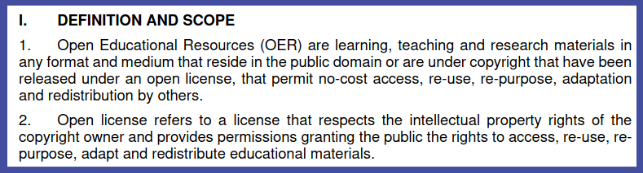
Figure 1. OER definition in UNESCO’s 2019 Recommendation on OER5
Assertion: Materials/documents/works in the public domain (PD) are OER.
Generally, a work is considered to be in the public domain when: (1) The copyright protection term of the work has expired under national copyright law; (2) The author of the work has waived his rights and dedicated it to the public domain, usually through the use of the Creative Commons CC0 public domain tool for the work.
National intellectual property and/or copyright law provisions regarding public domain and International Public Domain Day
The term of copyright and related rights protection under the national laws of different countries can vary. Vietnam's Intellectual Property Law 20256, as generally stipulated in Article 27 on the Term of Copyright Protection and Article 34 on the Term of Related Rights Protection, is 50 years after the author's death, while that of the United States is 70 years7. This means that, if you comply with Vietnam's intellectual property law, you can use works that are already in the public domain in both Vietnam and the United States, but the reverse is not necessarily true.
On January 1st each year, a number of works worldwide automatically enter the public domain after their national copyright protection term expires. This explains why this day is called World Public Domain Day8. A range of issues related to this Day are explained on the website of the Center for the Study of the Public Domain9.
Commonly, regardless of which country's intellectual property laws apply, once a work is digitized and in the public domain and available on the Internet, anyone, at minimum, has the right for no-cost access, re-use, re-purpose, adapt and redistribute it, just as defined by UNESCO's OER definition above.
Digitizing public domain works towards Open Cultural Heritage
On the one hand, it is readily apparent that, though not all, the majority of digitized public domain cultural heritage works are currently held in GLAM institutions and presented on the Internet through their websites. Some examples of websites with public domain works are: (1) The US Center for the Study of the Public Domain compiles a list of automatically public domain works on January 1st of each year10; (2) The Europeana cultural heritage website11 as of June 10, 2023, had nearly 20 million public domain works, including those with the Public Domain Mark and those dedicated to the public domain through the Creative Commons CC0 public domain tool, representing 34% of the total of over 56 million works on the Europeana website at that time; (3) The Gutenberg Project12 currently has nearly 78,000 ebooks that anyone can download for free to use (according to the US intellectual property law); (4) The MUSOPEN13, the open music website has over 100,000 PDF files of classical music sheets, all of which are in the public domain and free to download;…
On the other hand, the digitization of public domain cultural heritage works has yet to be addressed uniformly globally. While many countries lack specific regulations on the digitization of public domain works, potentially leading to unnecessary copyright disputes over digital versions, many others already have such regulations in place.
Since 2010, the Europeana’s Public Domain Charter14 has clearly demonstrated the principle that “work that are in the Public Domain in analogue form continue to be in the Public Domain once they have been digitised”, and emphasised the important role of the Europeana itself, the Public Domain and its works in general, as shown in Figure 2 below:
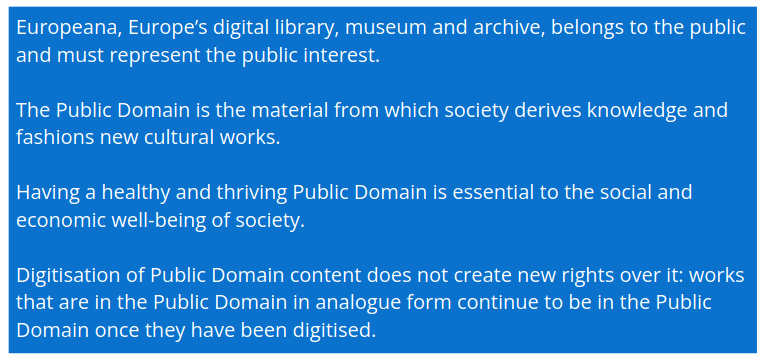
Figure 2. Key points of the Europeana 2010 Public Domain Charter
All of these key points of the Europeana 2010 Public Domain Charter remain unchanged in its latest 2025 version15, alongside other updated content.
DIRECTIVE (EU) 2019/790 OF THE EUROPEAN PARLIAMENT AND OF THE COUNCIL of 17 April 2019 on copyright and related rights in the Digital Single Market and amending Directives 96/9/EC and 2001/29/EC16, Chapter 4: Works of visual art in the public domain, Article 14: Works of visual art in the public domain, pointed out that: “Member States shall provide that, when the term of protection of a work of visual art has expired, any material resulting from an act of reproduction of that work is not subject to copyright or related rights, unless the material resulting from that act of reproduction is original in the sense that it is the author's own intellectual creation.”
The Open Heritage Alliance, convened by Creative Commons, brings together more than 110 organizations from 30 countries17 around the world, has adopted the Open Heritage Declaration18 in October 2025 with the following 17 specific points:
Start citation:
We agree that non-original materials resulting from an act of reproduction of public domain heritage should not be subject to new copyright or related rights.
We agree that non-original materials resulting from an act of reproduction of heritage protected by copyright or related rights should pass into the public domain upon the expiration of those rights.
We believe that no open licenses may be applied to public domain heritage in the absence of meeting legal requirements to support the application of that license.
We agree that, where it is lawful and appropriate to do so, public domain heritage should be shared using standardized public domain tools that are preferably machine-readable.
We emphasize that acknowledgment of the source is important and we support measures that improve the public’s ability to reference institutions, creators and communities of origin.
We believe that freedom of expression and the development of new knowledge and creativity should not be unreasonably limited by moral rights that may survive in public domain heritage.
We encourage the removal of legal restrictions in national legislation that apply to heritage materials rightfully in the public domain.
We support the introduction of legal means for members of the public to clarify the copyright status of materials that may rightfully belong in the public domain.
We believe that contracts should not be used to override the freedoms associated with the public domain.
We support providing access to public domain heritage free from technical restrictions.
We support the creation and sharing of accessible-format versions of public domain heritage for persons with disabilities.
We emphasize the importance of developing the skills of heritage practitioners to effectively and confidently address legal and technological challenges, including barriers related to preservation and accessibility.
We encourage partnerships that foster openness, including for mutual capacity building and assistance, such as through knowledge exchange, training and equipment sharing.
We acknowledge the need for economic models that allow for the recovery of legitimate and reasonable costs incurred by institutions in the course of digitization and collections management without unduly restricting access to public domain heritage.
We believe in developing and maintaining open and sustainable digital public infrastructures which use robust preservation and access practices, protocols and standards, to ensure that digital heritage and metadata are accessible to enhance reuse and foster collaborative networks globally.
We acknowledge the need to transparently engage with, consult and involve communities of origin to enable free, prior and informed consent in decision-making processes involving both physical and digital heritage.
We recognize that there may be legitimate reasons not to digitize, allow access or openly share heritage, particularly where additional governance systems may apply.
We encourage policymakers and stakeholders to engage in a dialogue towards the promotion of equitable and open access to public domain heritage and for addressing the numerous undue and unfair barriers to such access.
End citation.
On April 29, 2026, the Open Heritage Alliance, in collaboration with UNESCO, organized an Exploratory Dialogue on Open Heritage19 at UNESCO Headquarters in Paris, France, “to celebrate the Open Heritage Statement and explore its synergies with UNESCO’s priorities in tackling the most urgent problems facing the world today,” and as a significant step toward the feasibility of an UNESCO’s Recommendation on Open Heritage in the future. The Dialogue brought together over 100 participants, including UNESCO staff, Permanent Delegation representatives, National Commissions, cultural heritage practitioners, funders, and open heritage advocates and enthusiasts from around the world. They “call on UNESCO Member States to join the dialogue towards additional action by UNESCO to ensure equitable access to public domain heritage in the digital environment, possibly even by co-creating a new normative instrument, in accordance with UNESCO’s existing normative framework. Recently, UNESCO has demonstrated a strong commitment to open through the 2019 Recommendation on Open Educational Resources (OER)20 and the 2021 Recommendation on Open Science21. These recommendations were game changers. A UNESCO Recommendation on Open Heritage would be the next logical step. To achieve this, UNESCO Member States should explore the feasibility of elaborating a standard-setting instrument (a Recommendation) that would proactively promote and encourage open solutions to removing barriers to accessing heritage in the public domain, being mindful of the various governance frameworks that determine the ways in which heritage is shared and used.”
Open Heritage COMPANION, a guide for the Journey from Closed to Open22 – the result of this exploratory dialogue – was published in July 2026 to help GLAM institutions and cultural heritage organizations transform their collections and cultural heritage resources from closed to open and heading toward Open Heritage, which is defined as:
“Open Heritage refers to heritage that is made as openly accessible for sharing and reuse as possible and free from unfair and unnecessary copyright restrictions in the digital environment. The term encompasses all forms of heritage, including heritage held in the collections of cultural heritage institutions, heritage sites and monuments, natural heritage, and documentary heritage, and any associated metadata. In particular, a central tenet of open heritage is that digital reproductions of public domain works should be made available for free and without restrictions.”
Relation between OER, digitalized public domain’s cultural heritage works
The document "Don’t be a dinosaur; or, the benefits of Open Culture"23 defines Open Culture (OC) and focuses primarily on a sub-field of open culture: open cultural heritage. One of the four key benefits of open culture is that it leads to "more vibrant research and more participatory education," which is detailed as follows:
Start citation
OC can galvanize researchers by offering them access to untapped resources and empower educators and learners to create and remix resources. OC helps create a bigger, richer and more meaningful conversation around collections outside of an institution's four walls for people to express themselves in their own voices, to make new discoveries, create new narratives or reshape those distorted through history, find new meanings, offer new (critical) perspectives, and make new interpretations of our past to inform our futures by opening new horizons.
What is impossible today because culture is not open?
Researchers and scholars cannot freely access and reuse cultural heritage and information about it for the purpose of research (despite heritage being in the public domain or reliance on a copyright exception). As a result, research is slowed or outright thwarted — our global knowledge about cultural heritage, its context, and impact on our world is impoverished; historical biases pervade.
Teachers and educators are not able to legally access and share online the digital materials from cultural heritage collections they need to exchange knowledge.
Learners are deprived of knowledge resources essential to their program.
Who benefits? Researchers, scholars, teachers, educators, and learners.
Key benefits:
increased generation of new knowledge
bolstered collaboration opportunities, increased unity, broader impact
greater possibilities for remote education and online teaching
more participatory and inclusive teaching and learning
End citation
The document cites various expert opinions representing GLAM institutions worldwide regarding Open Culture, one of which states: “OC is a crucial approach to building open educational resources (OERs) that can benefit learners and teachers as resources can be retained, remixed, revised, reused, and redistributed — the “5 R” activities”; and another notes: “The Hunt Museum had a major advantage when we all had to create museums from home at the start of the COVID pandemic, partly because a sizeable chunk of the collection was available in digitized form under PDM or CC0. We'd already had experiments with Mozilla Hubs and could reach out to schools and parents to provide curricular-supported learning using the museum's objects.”
This demonstrates that Open Culture—specifically Open Cultural Heritage, where public domain cultural heritage works are digitized and used with Creative Commons public domain tools such as the Public Domain Mark (PDM) or CC0, will benefit learners, educators, and researchers alike; in other words, when such works are situated within the context of "learning, teaching, and research materials," at minimum for cultural education, they align precisely with the definition of OER established by UNESCO. Furthermore, from the perspective of Creative Commons (CC) licensing, such works possess a higher degree of legal openness compared to OERs licensed under CC licenses like CC BY, CC BY-SA, CC BY-NC, and CC BY-NC-SA, as they entail no copyright restrictions, as shown in Figure 3.
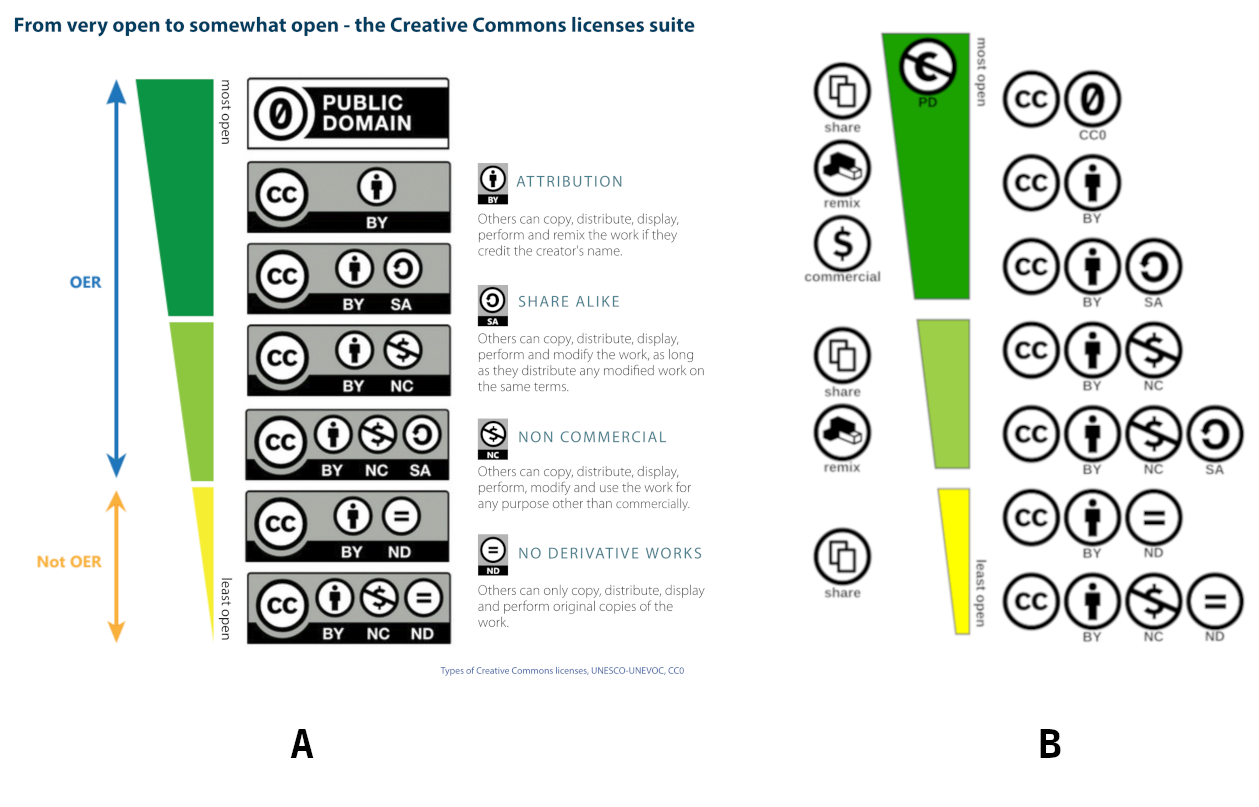
Figure 3. CC licenses suite without (A24) and with (B25) Public Domain Mark tool
There may be legitimate reasons not to digitize, allow access or openly share heritage, particularly where additional governance systems may apply
On the one hand, this manuscript focuses on the emphasizing the important principle that digitizing public domain works does not create new rights and that such digital reproductions should, in principle, remain openly available. On the other hand, as indicated by Point 17 of the Open Heritage Declaration mentioned above, “there may be legitimate reasons not to digitize, allow access or openly share heritage, particularly where additional governance systems may apply”, such as for Indigenous People's cultural heritage within the context of their colonial history.
The document "Guidelines on Indigenous Collections and Data" specifies that even Indigenous cultural heritage works in the public domain should only be digitized and made publicly available with the consent and participatory management of the Indigenous communities themselves. It suggests that data of such works should be managed according to the CARE (Collective Benefit, Authority to Control, Responsibility and Ethics) principles and/or in conjunction with the FAIR (Findable, Accessible, Interoperable, Reusable) principles as follow: “The 2007 United Nations Declaration on the Rights of Indigenous Peoples sets minimum international standards around Indigenous intellectual and cultural property and the principles of participation and free, prior, and informed consent, while the CARE Principles for Indigenous Data Governance and FAIR Principles establish frameworks for the governance of Indigenous data. These considerations mean that some heritage materials may, through discussions with communities, not be suitable for open access.26” The document also suggests using a combination of CC licenses and supplementary "Local Text" labels and notices for works authorized for digitization and open access.
Suggestions for Vietnam’s GLAM institutions and Cultural Heritage Organizations
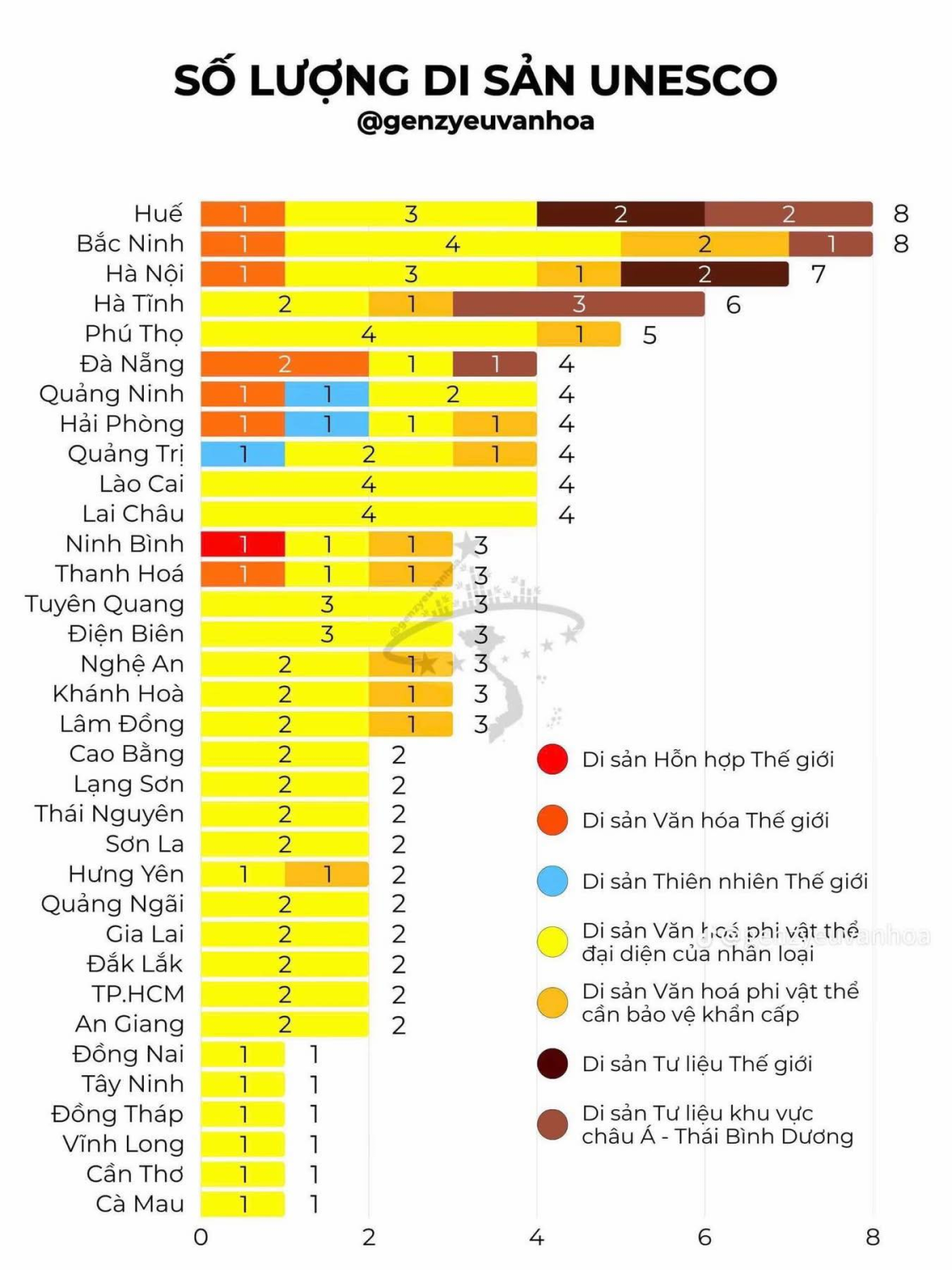
Figure 4. Number of UNESCO heritage sites in Vietnam’s provinces and cities
According to data from the Vietnam Economics27, Vietnam is a country with many cultural heritage sites recognized by UNESCO, as shown in Figure 4.
In accordance with the spirit of Decision No. 611/QD-TTg approving the Project "Digital Transformation in the Cultural Sector until 2030, with a vision to 2045" mentioned at the beginning of this article, along with several other related documents, the digitization of heritage resources in all forms has certainly been and is being implemented increasingly actively at GLAM institutions and cultural heritage organizations in Vietnam.
Although there are no specific statistics to show whether the digitization of heritage resources at GLAMs and cultural heritage organizations in Vietnam adheres to the core principle of open heritage, which is that digital reproductions of public domain works should be made available for free and without restrictions, while such works are also Open Educational Resources by UNESCO’s definition, and therefore, anyone, at a minimum, has the right to no-cost access, reuse, repurpose, customize, and redistribute them.
Hopefully, in the near future, the Ministry of Culture, Sports and Tourism will provide specific guidance on this core principle so that digitized heritage resources of Vietnam will not only meet the requirements for implementing digital transformation in the cultural sector according to Decision No. 611/QD-TTg, but also with the Open Heritage Statement and heading toward to UNESCO's Open Heritage Recommendation as a global standard tool.
And always keep in mind in the digitization process of cultural heritage works in public domain that "Fundamentally, the open ethos neither condones unfettered and unconditional access, nor does it support unjustified and undue closedness. There are multiple forms, contexts, and stages of openness and the journey from closed to open is one of relationship building and partnership.28"
References
Government website: Decision No. 1117/QD-TTg dated September 25, 2023 of the Prime Minister approving the Program of building OER’s models in higher education: https://chinhphu.vn/?pageid=27160&docid=208699
Law on Higher Education No. 125/2025/QH15 (2025): https://datafiles.chinhphu.vn/cpp/files/vbpq/2026/01/luat125-2025.pdf
Government website: Circular No. 61/2026/TT-BGDĐT dated July 17, 2026 of the Ministry of Higher Education stipulating the exploitation and use of open educational resources in higher education activities: https://chinhphu.vn/?pageid=27160&docid=218966&classid=1&typegroupid=6
Government website: Decision No. 611/QD-TTg approving the Project “Digital Transformation in the Cultural Sector until 2030, with a vision to 2045”: https://vanban.chinhphu.vn/?pageid=27160&docid=217529
UNESCO, (2019): Recommendation on Open Educational Resources (OER): https://unesdoc.unesco.org/ark:/48223/pf0000373755/PDF/373755eng.pdf.multi.page=3, page 5.
Government website: Consolidated text No. 155/VBHN-VPQH of the National Assembly Office: INTELLECTUAL PROPERTY LAW, dated September 9, 2025: https://vanban.chinhphu.vn/?pageid=27160&docid=215309
U.S. Copyright Office: How Long Does Copyright Protection Last?: https://www.copyright.gov/help/faq/faq-duration.html
MIT Libraries: Public Domain Day: https://libraries.mit.edu/public-domain/
Center for the Study of Public Domain: Public Domain Day — Frequently Asked Questions: https://web.law.duke.edu/cspd/publicdomainday/faqs/
Center for the Study of the Public Domain: Public Domain Day 2026: https://web.law.duke.edu/cspd/publicdomainday/2026/
Le Trung Nghia, (2023) in Vietnamese: Digital Transformation and Copyright Issues in Library Activities - The Europeana Experience: https://zenodo.org/records/8137149
Project Gutenberg: https://www.gutenberg.org/
MUSOPEN: Free sheet music: https://musopen.org/sheetmusic/
Europeana, (2010): Public Domain Charter: https://pro.europeana.eu/files/Europeana_Professional/IPR/Public%20Domain%20Charter/ENGLISH%20Public%20Domain%20Charter.pdf, page 2.
Europeana, (2025): Public Domain Charter: https://pro.europeana.eu/files/Europeana_Professional/IPR/the_2025_europeana_public_domain_charter.pdf.
Official Journal of the European Union: DIRECTIVE (EU) 2019/790 OF THE EUROPEAN PARLIAMENT AND OF THE COUNCIL of 17 April 2019 on copyright and related rights in the Digital Single Market and amending Directives 96/9/EC and 2001/29/EC: https://eur-lex.europa.eu/legal-content/EN/TXT/?uri=CELEX:32019L0790
Open Heritage Statement: Signatories: https://openheritagestatement.org/signatories. Access July 28, 2026.
Open Heritage Coalition: Open Heritage Statement: https://static1.squarespace.com/static/68af5059dcd53a6da7c8c09c/t/68d171c6a269670ab066781b/1758556614580/OHS_Oct2025.pdf.
Brigitte Vézina, Dee Harris, Creative Commons (2026): How can Equitable Access to Heritage Help Solve Global Challenges? An Exploratory Dialogue: https://creativecommons.org/2026/05/06/how-can-equitable-access-to-heritage-help-solve-global-challenges-an-exploratory-dialogue/.
UNESCO (2019): Recommendation on Open Educational Resources: https://unesdoc.unesco.org/ark:/48223/pf0000373755/PDF/373755eng.pdf.multi.page=3.
UNESCO (2021): UNESCO Recommendation on Open Science: https://unesdoc.unesco.org/ark:/48223/pf0000379949.
Creative Commons (2026): Open Heritage COMPANION, a guide for the Journey from Closed to Open: https://creativecommons.org/wp-content/uploads/2026/07/English_CC-OH-Companion.pdf, p.6.
Brigitte Vézina, Connor Benedict: Don’t be a dinosaur; or, the benefits of Open Culture: https://creativecommons.org/wp-content/uploads/2024/04/Dont-Be-a-Dinosaur-or-The-Benefits-of-Open-Culture.pdf. © Creative Commons 2024. CC BY 4.0, p.4, p. 12-13, and p.14.
UNESCO - UNEVOC (2018): OER in TVET: https://connect.unevoc.unesco.org/up/OER-in-TVET.pdf. CC BY 4.0, p.5
Tailored from Wikimedia Commons: File:Creative commons license spectrum.svg: https://commons.wikimedia.org/wiki/File:Creative_commons_license_spectrum.svg. CC BY 4.0.
Creative Commons and Local Contexts (2026): Guidelines on Indigenous Collections and Data : https://zenodo.org/records/22237037, p.3
Vietnam Economics, April 20, 2026: The number of UNESCO heritage sites in 34 provinces and cities nationwide!: https://www.facebook.com/kinhtevietnam2026/posts/pfbid07W9A9D3ponggicU2K1CdkLz3niwMiLJ2vyS732execp22XPwhofD2DkMWj6ENoETl
Creative Commons and Local Contexts (2026): Guidelines on Indigenous Collections and Data : https://zenodo.org/records/22237037, p.38
------------------------------------
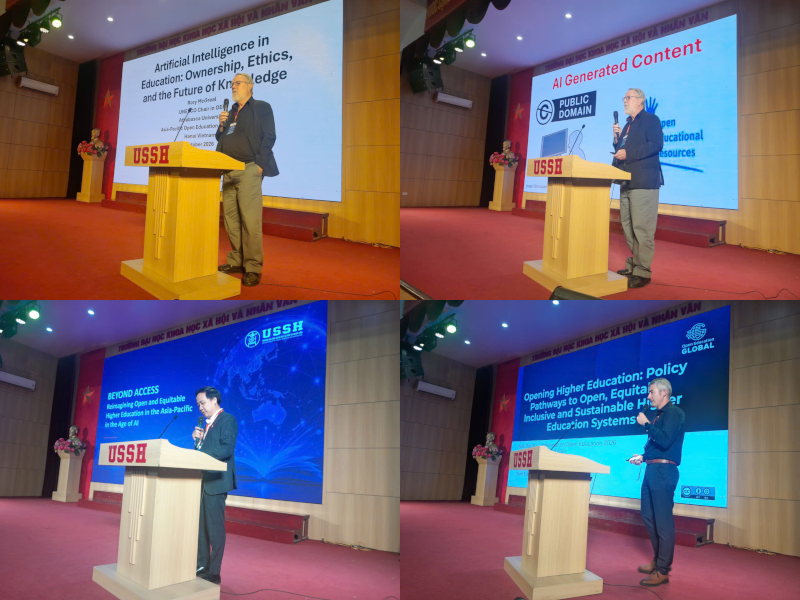
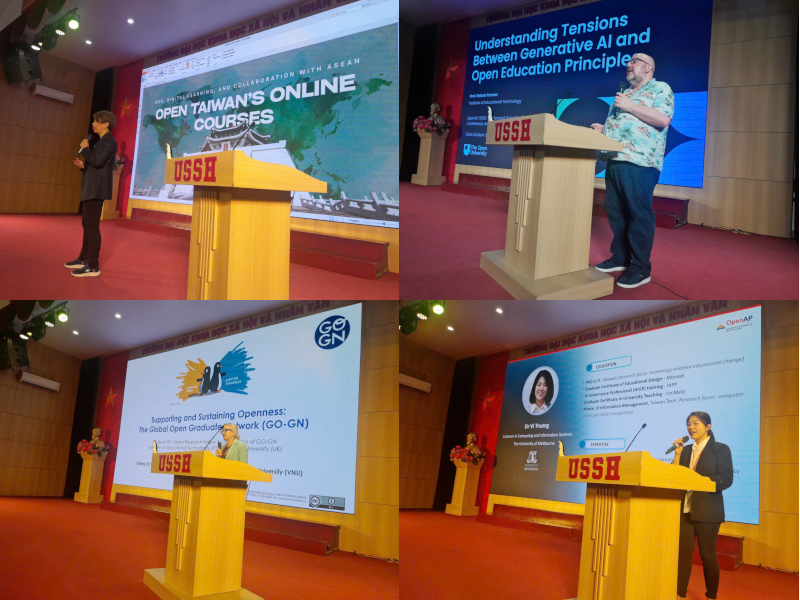
Bài viết cho Hội thảo của Châu Á - Thái bình dương về Giáo dục Mở năm 2026 - OpenAP 2026 (Asia-Pacific Conference on Open Education 2026) với chủ đề: “Một Tương lai Mở: Thúc đẩy Giáo dục Đại học công bằng và bao trùm trong khu vực Châu Á - Thái bình dương” (An Open Future: Advancing Equitable and Inclusive Higher Education in the Asia-Pacific Region) được tổ chức tại Đại học Khoa học Xã hội Nhân văn - Đại học Quốc gia Hà Nội ngày 23/10/2026.
Tự do tải về bài viết toàn văn định dạng PDF ở DOI: https://zenodo.org/records/23597853
Tự do tải về bài trình chiếu tại địa chỉ:
X(Tweet): https://x.com/nghiafoss/status/2113769133435502596
Xem thêm:
Tác giả: admin
Ý kiến bạn đọc
Những tin cũ hơn
Trang Web này được thành lập theo Quyết định số 142/QĐ-HH do Chủ tịch Hiệp hội các trường đại học, cao đẳng Việt Nam – AVU&C (Association of Vietnam Universities and Colleges), GS.TS. Trần Hồng Quân ký ngày 16/09/2019, ngay trước thềm của Hội thảo ‘Xây dựng và khai thác tài nguyên giáo dục mở’ do 5...
 Từ định nghĩa tài nguyên giáo dục mở của UNESCO tới việc định hướng việc số hóa các tác phẩm di sản văn hóa thuộc phạm vi công cộng trong các cơ sở di sản văn hóa hướng tới Di sản Mở (En)
 Giải quyết nghịch lý của Mở: Các nguồn lực mới để bảo vệ dữ liệu và nội dung hàng hóa công cộng kỹ thuật số (DPG) trong kỷ nguyên AI
 Vượt xa tính mở: Định hình tương lai AI có trách nhiệm thông qua đối thoại toàn cầu của Liên Hợp Quốc
 Thực hành tốt nhất để ngăn chặn AI khai thác nội dung mở và dữ liệu mở của DPG
 ‘Cẩm nang bảo vệ hàng hóa công cộng kỹ thuật số (DPG)’ - bản dịch sang tiếng Việt
 Tính mở & Chủ quyền kỹ thuật số: Ai duy trì các nguồn tài nguyên chung?
 Cách tiếp cận dựa trên nguyên tắc giữa bối cảnh nhiều biến động
 Độc giả của Giáo dục Mở
 Sổ tay Nghiên cứu Mở của Mạng lưới Cao học Toàn cầu Tài nguyên Giáo dục Mở - GO-GN (Global OER - Graduate Network)
 Các bài toàn văn trong năm 2025
 Các bài trình chiếu trong năm 2025
 Các lớp tập huấn thực hành ‘Khai thác tài nguyên giáo dục mở’ tới hết năm 2025
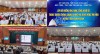 Tập huấn thực hành ‘Khai thác tài nguyên giáo dục mở’ cho giáo viên phổ thông, bao gồm cả giáo viên tiểu học và mầm non tới hết năm 2025
 Các tài liệu dịch sang tiếng Việt tới hết năm 2025
 DigComp 3.0: Khung năng lực số châu Âu
 Loạt bài về AI và AI Nguồn Mở: Công cụ AI; Dự án AI Nguồn Mở; LLM Nguồn Mở; Kỹ thuật lời nhắc; Tín hiệu CC
 Bộ các tài liệu hướng dẫn của UNESCO cho các chính phủ và cơ sở để triển khai Khuyến nghị Tài nguyên Giáo dục Mở
 Hướng dẫn thực hành về Giáo dục Mở cho các học giả: Hiện đại hóa giáo dục đại học thông qua các thực hành Giáo dục Mở (dựa trên Khung OpenEdu)
 Chứng chỉ Creative Commons cho các nhà giáo dục, thủ thư hàn lâm, và văn hóa mở
 Các mô hình bền vững Tài nguyên Giáo dục Mở (TNGDM) - Tổng hợp
 ORCID - Quy trình làm việc
 Tổng hợp các bài của Nhóm các Nhà cấp vốn Nghiên cứu Mở (ORFG) đã được dịch sang tiếng Việt
 Tổng hợp các bài của Liên minh S (cOAlition S) đã được dịch sang tiếng Việt
 Europeana - mô hình mẫu về hệ thống liên thông, Dữ liệu Mở (Liên kết) và dữ liệu FAIR của OpenGLAM/Văn hóa Mở
 Loạt bài về Khoa học Mở (KHM): Định nghĩa các khái niệm của KHM; Bộ công cụ KHM của UNESCO bản tiếng Việt; Năm KHM và chuyển đổi sang KHM;
 ‘ĐÁNH DẤU KHÓA HỌC MỞ VÀ KHAM ĐƯỢC: CÁC THỰC HÀNH TỐT NHẤT VÀ CÁC TRƯỜNG HỢP ĐIỂN HÌNH’ - VÀI THÔNG TIN HỮU ÍCH
 Khóa học cơ bản về Dữ liệu Mở trong chương trình học tập điện tử trên Cổng Dữ liệu châu Âu